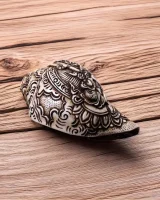
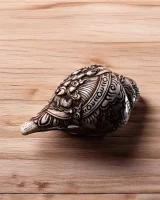
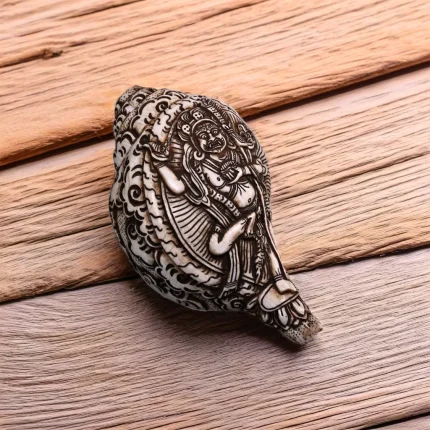
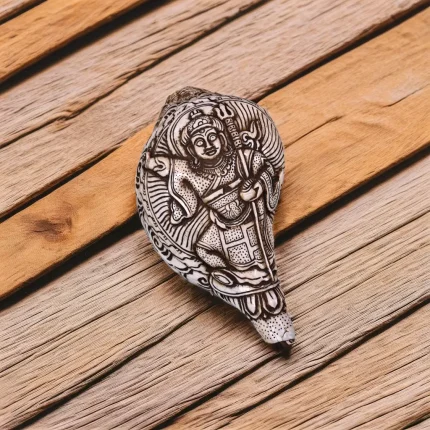
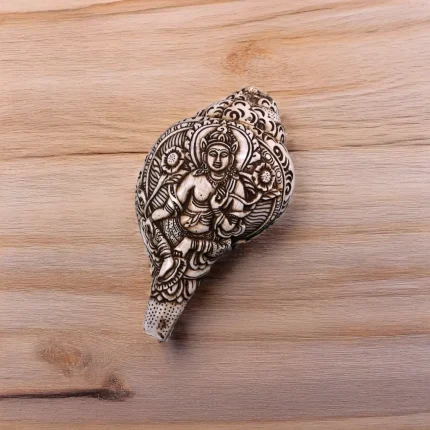
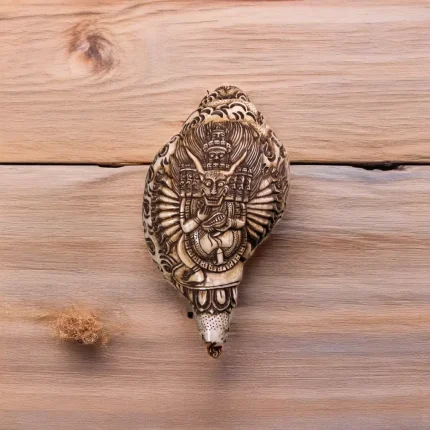
A conch shell carved with Red Jambhala, the figure associated with abundance.
A ritual conch, blown at an opening
Red Jambhala with his mongoose
Carved along the growth line, so each differs
Stands on its widest curve
$349.90
Out of stock
One shell, one spiral
The carving follows the shell's own growth line, so the composition wraps rather than repeats. Every shell came out of the sea with a different curve.
Red Jambhala, and the mongoose
A figure associated with abundance in Tibetan Buddhism. He is generally shown holding a mongoose, the traditional emblem of generosity in that iconography.
Sounded, or set down
Blown to open a ceremony where it is used ritually. Otherwise it rests on its widest curve, and needs no stand.
Enhance your spiritual journey with this divine Red Jambhala Conch Shell, a handcrafted masterpiece of Tibetan Buddhist art that resonates with the sacred sound of prosperity and wisdom. Carved from a natural white conch shell (Turbinella pyrum) by artisans in Tibet, this 8-inch long ritual object, known as the Jambhala Shakti Hand Carved, features intricate carvings of Red Jambhala, the wealth deity, adorned with a crown and a colored body, holding a jewel in his right hand and a mongoose in his left hand, with his left leg bent in a vajra position and his right leg extended, the leg is panhandle style.
Red Jambhala, a manifestation of Buddha Ratnasambhava from the Jewel Family, is believed to pour fortune and hold the power to create financial stability for sentient beings, helping to eliminate poverty and create material and spiritual wealth for both male and female practitioners. This Red Jambhala Conch Shell, with its snail and lotus flower base, produces a melodious sound as a musical instrument, inviting good fortune and banishing negative energies, making it perfect for sound healing, meditation, or ritual practice in Tibetan Buddhism, reflecting the traditions of Yellow Dzambhala over time.
This Red Jambhala Conch Shell connects you to the ancient Indian traditions of Tibetan Buddhist practices, where conch shells are used to invoke the power of Jambhala, the god of wealth, alongside his consort Vasudhara and Lord Vaisravana, to pour prosperity and fame. Jambhala is also believed to help eliminate poverty and create financial stability, as seen in Hindu mythology with the Hinduism Shankha, ensuring wealth and appropriately distributed abundance.
Available in our shop, this handcarved Tibetan Conch Shell, a part of our Tibetan Buddhist collection, reflects the spirit of the Yellow Dzambhala and White Jambhala traditions, with its swirl of his navel symbolizing abundance. For those concerned about ethical sourcing, rest assured: it’s sustainably harvested, ensuring cultural respect and environmental care, so you don’t have to wait for fortune to arrive. The price reflects its handcrafted quality, making it a valuable addition to your sacred space at an affordable cost. Use it in your sound healing sessions or display it as a symbol of spiritual wealth, and let its hand-carved design, with four arms of Red Dzambhala holding a mongoose, bring the blessings of Jambhala to your life. Buy this Red Jambhala Conch Shell online today to experience its transformative energy and create financial stability.
The shell shown, packed for transit.
Shells are supplied without a stand or mouthpiece unless one is named in the description on that product's page.
Material: Natural white conch shell (Turbinella pyrum)
Size: 8 inches long, 4 inches wide, ideal for rituals
Intention: Attracts prosperity and banishes negativity
Origin: Hand-carved by artisans in Tibet
Craft: Hand-crafted
Diameter: 8"
Three things tell you more about a shell than its price.
Size. The dimension is listed on each page. A shell meant to be sounded needs to sit comfortably in two hands; a shell meant to be displayed can be any size you like.
Carved or plain. Carved shells are worked by hand, which is slow, and the detail varies from piece to piece. A plain shell shows the natural form and its own markings.
What you will do with it. A shell kept on a stand and a shell actually blown are two different purchases. If you mean to sound it, say so before ordering and we will tell you what we know about the piece.
Every shell came out of the sea with its own shape and colour. No two are alike, and none is a second.
Orders are processed within one to two business days, Monday to Friday, with tracking on every parcel. Delivery across the continental United States then takes ten to twenty-five days.
Shipping is a flat $9.95, and free on orders over $180. We do not ship outside the United States at this time.
Changed your mind? You have thirty days from delivery to request a return. A bowl that has been played is still returnable - we only ask that it comes back complete and in its original packing. Approved refunds go back to your original payment method within three business days. Full terms are on our Returns & Refunds page.
An instrument first
A conch is sounded to open a gathering, and anyone may sound one. If you mean to blow it rather than stand it on a shelf, write to us first and we will say what we know about the piece.
No two shells, ever
Each one came out of the sea with its own shape, weight and markings. None of them is a second, and none matches its photograph exactly.
The piece people pick up
A carved shell is the thing visitors reach for and ask about. It is the one object on the shelf that was made to be held.
Frequently asked questions
Who is Red Jambhala?
A figure associated with abundance in Tibetan Buddhism, depicted in several colours of which red is one. He is usually shown holding a mongoose, the traditional emblem of generosity.
What does the conch shell symbolize in Buddhism?
It is one of the eight auspicious symbols: the teaching spoken aloud and carrying outward. A conch opens a ceremony.
Is a conch shell used in Hinduism too?
Yes - the shankha is important in Hindu practice as well, associated with Vishnu, and is sounded in temple ritual. The two traditions use the same object differently.
Can I keep this on a desk rather than an altar?
Of course. Many people keep a carved conch as an object rather than for ritual. If it does go on an altar, the usual courtesy is to keep it off the floor.
Carved through the shell itself
The design is cut into the shell wall, not moulded onto it, so the carving follows the growth lines the animal laid down. That is why no two are the same and why the relief runs deeper in some places than others. The mounting is worked separately in silver or gold-toned metal and fitted where the shell is held.
A conch opens, it does not close
In Tibetan practice the conch is sounded to open a ceremony or call a gathering together, never to end one. It is blown through an opening cut near the tip, with both hands steadying the weight. Anyone may sound one; there is no initiation attached to it.